Craft
What Is a Punjabi Jutti? Jutti vs Mojari vs Khussa Explained
Shops swap the words jutti and mojari all the time, and Pakistani sites add khussa to the mix. We make Punjabi juttis in Delhi, so here is what each name really means and how to tell the styles apart before you buy.
In this guide
Quick answer
A Punjabi jutti is a flat, closed slip-on shoe from Punjab with an embroidered upper over the toes and a back that rises to the heel, and in most of India mojari is simply another name for it. Khussa is the word used in Pakistan. Indian shops use it for heavier pairs covered in metallic thread.
What is a Punjabi jutti?
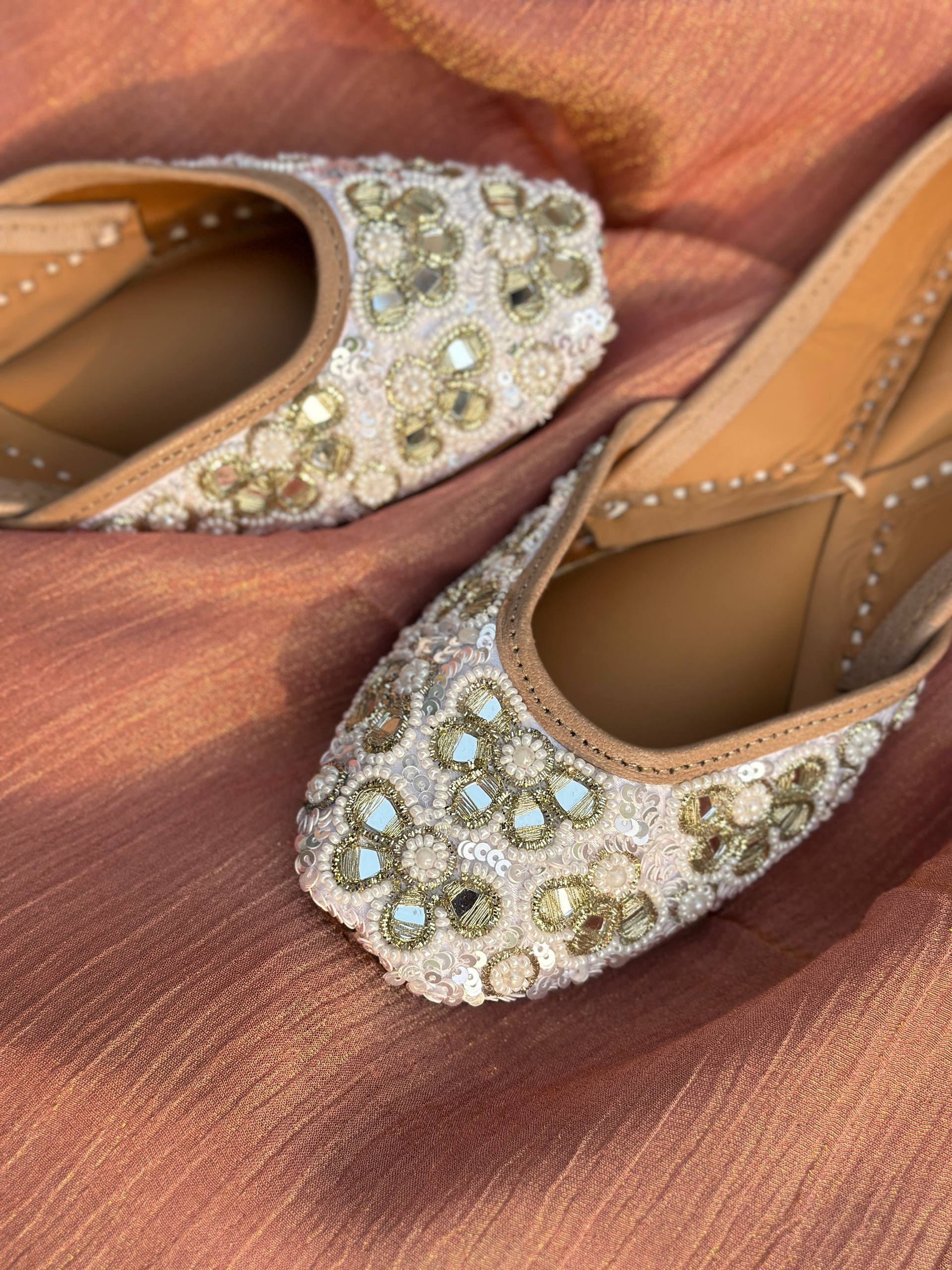
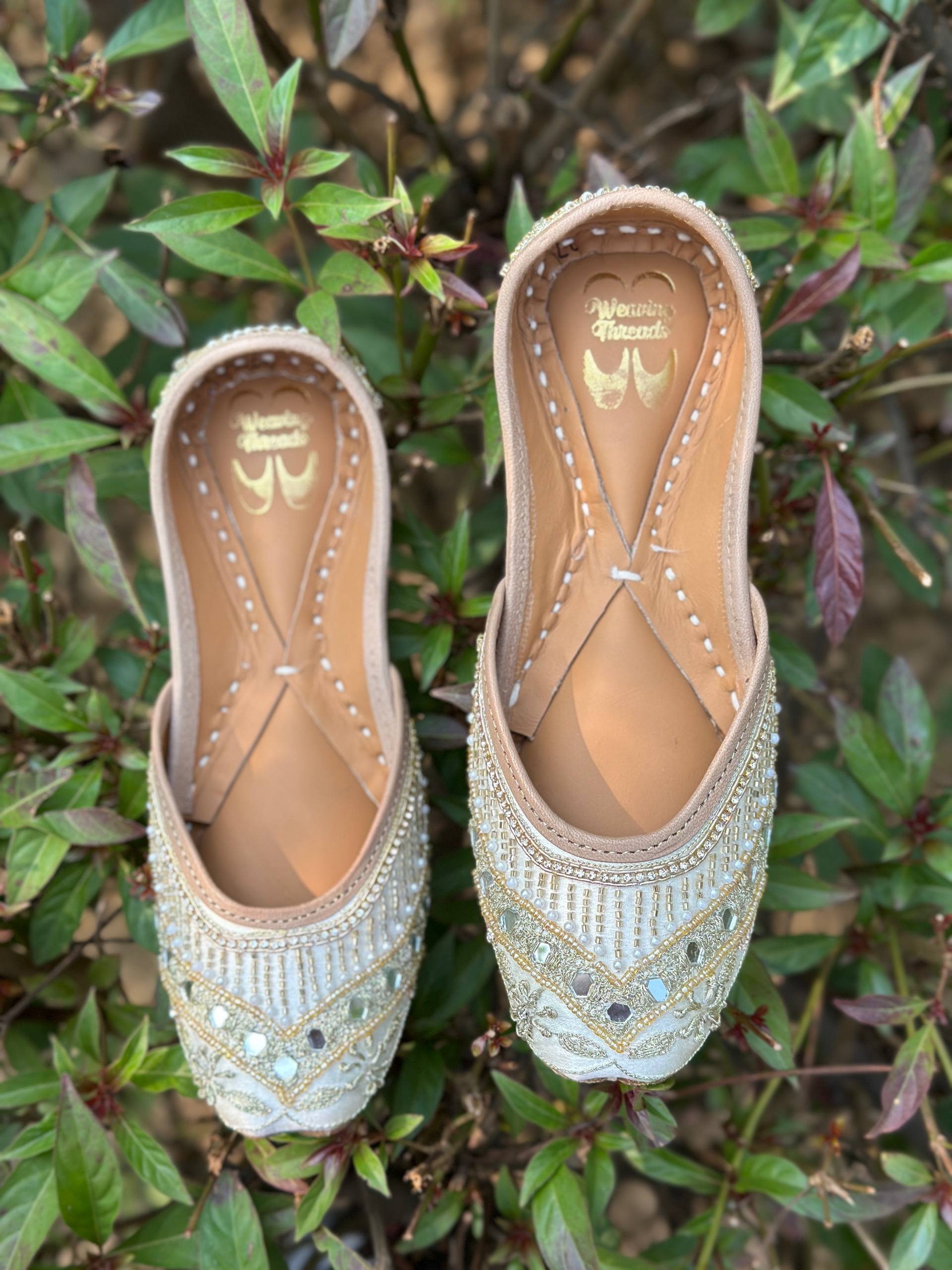
A Punjabi jutti is a flat slip-on shoe from Punjab with a closed toe. The upper wraps over the toes and is usually embroidered, while the back (the aeda) rises to sit just under the ankle bone and leaves the top of the foot almost bare. There is no heel.
Most pairs have no left or right foot. Both shoes are cut on the same straight shape and each one moulds to the foot that wears it over the first few days, which is why a new jutti feels snug at first.
Traditional makers build the shoe from two kinds of leather. In Fazilka, near the Pakistan border, the sole is cut by hand from thick buffalo hide while the upper and back come from cowhide, according to a Sahapedia field study. One shoemaker interviewed by PARI in Sri Muktsar Sahib district pierces the leather roughly 400 times to hand-stitch a single pair. That is before any embroidery starts.
Juttis are a small handmade corner of a very large industry. India made 2,579 million pairs of footwear in 2018, about 10.7% of world production and second only to China, according to Invest India.
Where are Punjabi juttis made?
Patiala and Amritsar are the best-known jutti towns, and Patiala's gold-thread tilla jutti became the version most people picture today (Wikipedia). Fazilka and Sri Muktsar Sahib follow close behind. Their roots often run back to Rajasthan. PARI reports that thousands of jutti-making families moved from Rajasthan to Punjab in the 1950s, citing a 2017 study by a Sri Muktsar Sahib college.
Is a mojari the same as a jutti?
Mostly, yes. In everyday Indian shopping the two words describe the same flat closed shoe, and Wikipedia's entry on the jutti notes that elsewhere in India juttis are "commonly also known as mojari." The difference is history and region more than construction.
Mojari is the name tied to Rajasthan and to the Mughal and Rajput courts, where the grandest pairs were made for royalty and men's styles often ended in a long pointed toe that curled up at the tip. Sahapedia describes the Punjabi jutti as sharing "affinities with the mojari" while adapting to Punjab. Many Punjab jutti families trace their roots to Rajasthan, so the overlap makes sense. Same family, different accent.
Sellers still lean on the words differently. "Mojari" often signals a pointed toe that may curl at the tip, and it is a common word for men's wedding pairs. We call every pair we make a jutti.
What is a khussa?
Khussa is the Pakistani name for the same family of shoes. Wikipedia describes the Sindhi khusso and the Multani khussa as traditional footwear of Sindh and Punjab in Pakistan, made by hand by local artisans, mostly from vegetable-tanned leather.
On Indian shop shelves the word has picked up a narrower meaning. A pair sold as a khussa is usually heavier and more metallic than an everyday jutti, with dense gold zardozi or tilla thread covering almost the whole upper so that very little base fabric shows. Think wedding, not office.
We make these Pakistani-style designs in our own Delhi workshop rather than importing them. You can see the whole set in our khussa for women edit.
Jutti vs mojari vs khussa at a glance
| Jutti | Mojari | Khussa | |
|---|---|---|---|
| Where the name is used | Punjab and most of north India | Rajasthan, and across India as a general name | Pakistan (Sindh and Punjab); Indian shops use it for Pakistani-style pairs |
| Toe | Women's pairs: rounded or softly pointed. Men's pairs: pointed, sometimes curled | Often pointed; men's pairs may curl up at the tip | Often pointed; men's pairs may curl up |
| Back | Closed, rising to just under the ankle bone (backless "half juttis" also exist) | Closed back, or backless like a mule | Usually closed |
| Typical work | Thread and zari embroidery, tilla, mukaish, mirrors, beads | Thread or zari embroidery, mirrors, beads, cowrie shells, brass studs | Embroidery and studding; in Indian shops, dense tilla or zardozi over most of the upper |
| Usual occasions | Everyday wear to bridal | Weddings and festive wear | Weddings and festive wear |
| At Weaving Threads | Every pair in our range | Not sold as a separate style | Pakistani-style pairs in our khussa edit |
Read the table as a guide to how the names are used, not as hard rules. A mojari from Jodhpur and a jutti from Patiala can look almost identical, and plenty of shops print all three words on one product to catch every search.
What are the main types of jutti?
Juttis are sorted by the work on the upper. Our range had 192 live designs when we checked the catalogue on 27 November 2026, and 152 of them are hand-embroidered on fabric or leather. The rest are mukaish (33) or tilla (7). Each suits a different day.
Embroidered juttis
Embroidered pairs are worked in thread and zari. Many add sequins or pearls or tiny mirrors. They run from light florals that sit happily under a cotton kurta all the way to bridal pairs where every centimetre of the toe is covered. Prices run from Rs 1,150 to Rs 2,150.
Mukaish juttis
Mukaish, also called badla, is metallic dotting hammered into leather by hand. All 33 of ours have leather uppers. Every one costs Rs 1,350. For daily wear these are the pairs we suggest first, because leather gets softer and more comfortable the more you wear it.
Tilla juttis
Tilla is metallic thread laid across the whole upper, the style that made Patiala famous. Our 7 tilla pairs cost Rs 1,550 to Rs 1,650.
Half juttis and backless styles
A half jutti covers the toes but has no back, so it slips on like a mule. Some people call these half mojaris. We do not make them: every pair in our range has a full back, which keeps the shoe on your foot through a long day of standing and dancing.
Which one should you buy?
Choose by the day you are dressing for, not by the name on the label. This table matches common occasions to the work that suits them in our range.
| Occasion | Look for | In our range | Price |
|---|---|---|---|
| Office and daily wear | Leather upper, light work | Mukaish juttis | Rs 1,350 |
| Mehendi, haldi, day functions | Colourful thread or bead florals | Mehendi and haldi edit | Rs 1,550 to Rs 1,850 |
| Sangeet and evening parties | Mirrors and sequins on a darker base | Sangeet and party edit | Rs 1,550 to Rs 1,750 |
| Wedding day and reception | Dense zardozi, pearls, tilla | Bridal juttis | Rs 1,550 to Rs 1,850 |
| Pakistani-style outfit | Metallic work over the whole upper | Khussa edit | Rs 1,550 to Rs 1,750 |
Getting the size right
Our juttis come in EU 35 to 41 (UK 3 to 9). Order your usual size. A new pair is meant to feel snug, and the leather loosens and moulds to you over the first few wears, so wear it at home for an hour or two at a time to start. Still wrong? Our refund policy allows a size exchange within 7 days of delivery if the pair is unworn and back in its box.
Where to buy handmade Punjabi juttis
Every pair we sell is designed in-house and handmade, with a soft leather lining and a cushioned footbed on a flat sole that stays comfortable through a long function. All of them sit in our Punjabi juttis for women collection. Prefer to shop by craft? Start with embroidered juttis, then compare our mukaish pairs with the tilla edit.
Want to try before you buy? Our store is at E-22, Lajpat Nagar-2 in New Delhi, and the contact page has directions.
Once you have a pair, our guide to cleaning and storing juttis will keep it looking new.
Good to know
Questions shoppers ask
What is a jutti called in English?
There is no exact English word. Jutti is usually translated as an Indian slip-on shoe or an embroidered flat shoe, and English-language shops often keep the words jutti and mojari as they are.
What does jutti mean in Hindi?
Jutti (जूती) is the Hindi and Punjabi word for a light flat shoe, especially a women's one. Juta, the masculine form, is the everyday word for any shoe.
Is a half jutti the same as a mojari?
No. A half jutti is a backless jutti that slips on like a mule, while most mojaris have a closed back. Some Sindhi mojaris are mule-style too, so check the product photos for the back before you order.
Are Punjabi juttis made of leather?
Traditionally, yes. Makers used buffalo hide for the sole and cowhide for the upper. Cheaper pairs often swap these for rubber and rexine. Every pair we make has a soft leather lining and a cushioned footbed, and our 33 mukaish pairs have leather uppers too.
Do juttis have a left and right foot?
Traditional juttis do not. Both shoes are cut the same and each one shapes itself to the foot that wears it over the first few wears, which is why a new pair feels tight at first.
How much does a handmade Punjabi jutti cost?
It depends on the materials. Sahapedia found Patiala juttis usually selling for Rs 400 to Rs 1,500 and Fazilka pairs for Rs 2,000 to Rs 5,000. Ours cost Rs 1,150 to Rs 2,150 as of 27 November 2026.